On June 11, Ting Yang, CEO of SOIN AI, was invited to attend "Intelligence Opens New Horizons: Google Empowers the Global Chinese Innovation Ecosystem," held at the Google Singapore Office. On June 12, SOIN AI appeared again at the "Unique Bloom 2026 · SG AI Agent Summit." The two back-to-back events formed a high-density presence for SOIN AI in Singapore this week, allowing the team to deliver a clear, focused message along two main threads: how AI-native applications achieve real adoption, and how AI agents move toward global commercialization.

If the industry's focus over the past year was the rapid iteration of model capabilities, then in 2026 more and more discussions have turned to the same question: can AI actually enter real business, deliver reliably, and ultimately generate revenue? The Google Singapore event framed the question as "how AI-native companies achieve global growth with the Google technology ecosystem," while the Unique Bloom summit pushed the focus further to AI agent commercialization, GTM, localization, compliance, revenue growth and global expansion. The two venues look different, but both answer the same thing: the next stage of AI is no longer about capability showcase, but business fulfillment.
At Google Singapore, SOIN AI Discussed "the Real Threshold for AI-Native Applications"
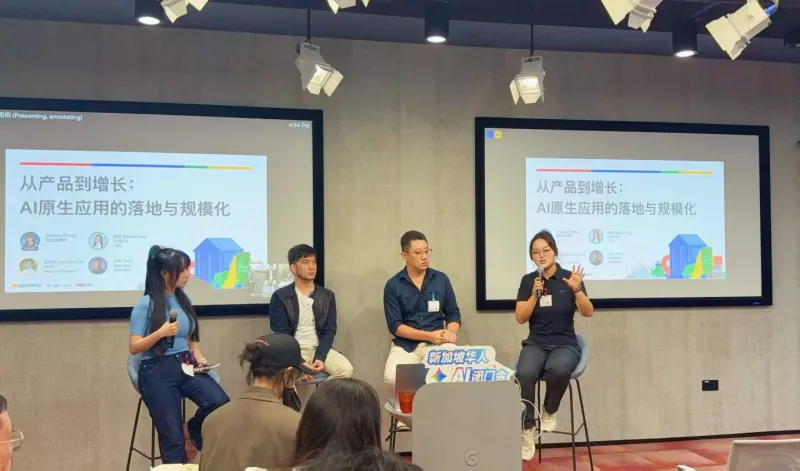
In the discussion at Google Singapore, Ting Yang offered a penetrating judgment on the adoption and scaling of AI-native applications: what enterprises really need to solve is not whether AI is smart enough, but whether AI can enter the chain of business accountability.
This is also the product philosophy SOIN AI has consistently upheld. So-called AI-native does not mean bolting an AI feature onto an existing product, nor packaging model capability as a more conversational entry point. True AI-native means reorganizing tasks, processes, collaboration and delivery around AI, so that the product shifts from "providing capability" to "driving outcomes." In Ting Yang's view, what enterprise customers ultimately pay for is never a dazzling demo, but whether a system can truly enter the process, connect systems, carry business rules, and deliver verifiable, traceable, sustainable results. These views naturally echoed the event's official emphasis on "turning technology into global business opportunities."
Going further, for an AI product to cross from Demo to Product, the hardest gap is often not the model but trust and delivery. Models can become stronger in a short time, but the thresholds in enterprise scenarios do not automatically disappear: whether terminology is accurate, how permissions are controlled, how processes connect, how exceptions are handled, and who is accountable for results — these together determine whether an AI system can move from "demonstrable" to "deployable." SOIN AI's practice in enterprise-grade agents, industry agents and complex workflow automation has revolved around exactly these questions: not proving whether AI can generate, but getting AI to truly enter the business chain and drive professional work.
At the Unique Bloom Summit, SOIN AI Was Placed in a Larger Industry Coordinate

Held on June 12 and organized by Unique Research, the Unique Bloom 2026 · SG AI Agent Summit was a high-density summit centered on the globalization of AI agents, with discussion topics including commercialization, GTM and localization, revenue growth, compliance and trust, and infrastructure and ecosystem collaboration. The summit also selected and announced the SG AI 30 list, which focuses on AI nativeness — meaning AI is a core component of the product capability, business model or industry solution rather than an add-on feature or marketing label — and on deployment value, meaning verified commercial adoption or ecosystem influence in their respective tracks. This list is not a ranking of funding size or fame, but a genuine record of "substantive AI value."
At the summit, SOIN AI was announced as an SG AI 30 honoree. This is both recognition of the SOIN AI brand and a sign that SOIN AI is now being observed within the larger frame of reference of the Singapore and Asia-Pacific AI ecosystem: no longer just "does it have technology," but "does it have AI nativeness, commercial deployment capability and ecosystem influence." In today's AI industry context, this shift of coordinates means more than a moment of exposure.

Notably, at this summit SOIN AI was not only present in panel discussions but also seen in a fuller brand form. In addition to Ting Yang's on-site participation, the organizers provided SOIN AI with an exhibition booth. Around enterprise-grade agents, industry agents, complex workflow deployment and AI marketing content production, SOIN AI attracted sustained attention from investors, channel service providers and potential customers. The conversations did not stay on stage but naturally extended to the booth: deployment approaches in real enterprise scenarios, cross-regional cooperation opportunities, the ability to replicate industry solutions, and an AI content production platform for retail brands and SMBs — the exchanges were lively. For SOIN AI, this kind of direct feedback from the front lines of the market is itself a weighty signal.

SOIN AI's Three Judgments Formed the Core Message of This Singapore Appearance
From Ting Yang's remarks and exchanges across the two events, SOIN AI conveyed three distinct layers of viewpoint.
First, the competition in AI-native products is not "who wires up models faster," but who can rebuild the business itself. True AI-native is not adding AI to old structures, but restructuring workflows, collaboration and delivery paths around AI. Whoever can distill the knowledge, processes, systems and experience of a business into executable capabilities has the better chance of building a long-term moat.
Second, on the road from demo to scale, what matters most is not a slightly stronger model, but whether the product deserves long-term trust. Enterprises do not pay indefinitely for a demo; they pay for sustainable business outcomes. Controllable, explainable, governable and deliverable — these are the real criteria for enterprise AI once it enters deep water.
Third, going global from Singapore is not simply copying capability, but replicating "validated results." Models can be shared globally, but customer success, compliance, delivery approaches and local ecosystem collaboration usually must be built place by place. Whoever can turn a scenario into a reusable result rather than a one-off case truly has the foundation for globalization.
These judgments also explain why SOIN AI appeared at both kinds of occasions: discussing product on one side and commercialization on the other; discussing delivery on one side and globalization on the other. For SOIN AI, they were always different facets of the same thing.
What Matters Most Is Not the Event Itself, but the Connections It Built

Unique Research has long focused on AI-native innovation, the global startup ecosystem and the evolution of applied AI, and continually builds cross-border platforms connecting founders, investors and ecosystem partners, concentrating on research into domestic, cross-border and global enterprise service ecosystems in business scenarios. Master Concept was founded in 2003, has long served enterprise customers across the Asia-Pacific, and is a Google Cloud Premier Partner with professional capabilities in enterprise digitalization, cloud services and AI applications.
SOIN AI is therefore especially grateful to Unique Research, Master Concept and Google Cloud for co-creating such a high-quality exchange venue. For an AI company genuinely committed to deployment, delivery and revenue, the most valuable thing is not the stage time itself, but being able to connect, in the same space, with people who truly understand industry, technology and growth. Whether the high-density discussions on AI-native applications at the Google Singapore event, or the front-line dialogue that extended from panel to booth at the Unique Bloom summit, they all made SOIN AI feel more clearly: today's AI industry is moving from "watching the excitement" into a stage of "watching the results."
From Product to Revenue, from Singapore to Broader Markets
From Google Singapore to the SG AI Agent Summit, from stage to booth, from product viewpoints to on-site conversations, the signal SOIN AI sent on this Singapore trip was clear enough: the next stage of AI is no longer just demonstrating capability, but delivering on it; no longer just providing tools, but building organizational capability.
This is exactly what SOIN AI has been doing — converting the business capability that enterprises accumulate in documents, systems, processes and expert experience into organizational capability that AI can understand, execute, verify and continuously optimize. Whether in enterprise-grade agents, industry agents, or AI marketing content production platforms for retail brands, cross-border e-commerce and SMBs, SOIN AI's focus is never one-off "generation" but sustainable delivery of results. SOIN AI's platform already covers Xiaohongshu posts, Douyin short videos, e-commerce product detail pages, batch marketing asset generation, multi-model API access and agent-automated workflows.
For today's AI companies, what truly endures across cycles is never the one that tells the best story, but the one that best enters real business, best carries complex processes, and is most used by customers over the long term. SOIN AI is continuing forward on this path.