Продукт, спроектированный под ваш бизнес
Battery usage, maintenance, care and performance optimization management — extending battery life, increasing charge capacity and reducing environmental impact. The EUBMMO system integrates monitoring, data acquisition, analysis, diagnosis, care and maintenance for UPS and critical power systems.
Why do batteries need maintenance?

Salt crystallization
Crystallization increases the internal resistance of the battery.
Capacity decline
Capacity drops to 80% when internal resistance reaches 1.3 times the factory value, and to 30% at 2 times.
Shorter service life
The actual service life is only 50% of the design life, and more than 70% of lead-acid batteries are scrapped because of salt crystallization.
Why correct maintenance matters
A battery is an electrochemical device that converts chemical energy into electricity. Its efficiency and economic life decline with usage, and degradation accelerates without proper maintenance. In battery packs, growing inconsistency between cells is also a root cause of whole-system degradation.
Battery life is decided by two factors: build quality and maintenance. Most batteries never reach their economic life for lack of effective maintenance tools — with proper maintenance, both life cycle and work quality improve significantly.
Preventive maintenance
Improves reliability by preventing accelerated degradation.
Predictive maintenance
Uses measurement data and trend analysis to predict battery health and expected economic life.
Corrective maintenance
Provides remedies for detected risks or occurred faults.
Defects of traditional online monitoring
Despite strict procedures and installed monitoring devices, battery accidents still happen because traditional online devices cannot warn of these hidden risks:
Voltage collapse / reversal
Cells with normal float voltage but low SOC suddenly drop or reverse when the pack discharges.
Hidden open circuit
A cell with normal float voltage but a hidden open circuit fails as soon as the pack discharges.
Loose-plate overheating
Loose plate connections show normal float voltage but overheat and spark during discharge.
Whether a battery carries enough charge is the key test. Internal resistance barely changes between 30% and 100% SOC, yet current O&M relies heavily on resistance readings — an unreliable indicator on which safety cannot be pinned.
Core maintenance features

Dissolve formed crystals
Applies a unique pulse maintenance current to each cell through its dedicated supplementary charging circuit to eliminate internal crystallization.
Learn more
Precision resistance measurement
Measures the internal resistance of each cell precisely by applying a regulated constant-voltage current in a time-shared manner.
Learn moreSOC capacity calculation
Calculates the SOC of every cell from the built-in experience database and factory standard parameters.
Learn more
Eliminate degradation
Removes internal resistance and cell differences, keeps every cell fully charged and extends service life.
Learn more
Online monitoring & maintenance
Collects, detects, analyzes and evaluates the status of each cell and the pack online, detects degradation early and maintains automatically.
Learn moreTen capabilities of the EUBMMO system
1. Online open-circuit detection
A single open-circuit cell disables the whole pack, even though it still shows a voltage.
2. Online hidden-reversal detection
A cell with normal float voltage turns negative on discharge, collapsing pack voltage and dropping the load.
3. Online loose-plate detection
Loose plate connections spark during charge/discharge and cut power to the load.
4. Bus-disconnection warning
Warns when a failed fuse or open switch disconnects the battery pack from the DC bus.
5. Weak-cell identification
Identifies cells with acid creep, severe water loss or low SOC before they drag the whole pack down.
6. Reducing cell differences
Reduces cell-to-cell differences online and raises charge power — smaller differences mean longer life and fewer risks.
7. Cell-level replacement
Replaces single degraded cells instead of the whole pack, minimizing differences and maximizing charge power.
8. Online SOC monitoring
Derives the SOC of every cell from measured voltage and computed internal resistance.
9. Sulfation reduction
Reduces sulfation resistance online and maximizes charge power through differentiated supplementary charging.
10. Performance traceability
Traces battery performance over time for early warnings — from fix-on-failure to proactive maintenance.
System architecture
The EUBMMO system consists of six modules: main control module, maintenance module, charger, current sensor, maintenance server and maintenance software.
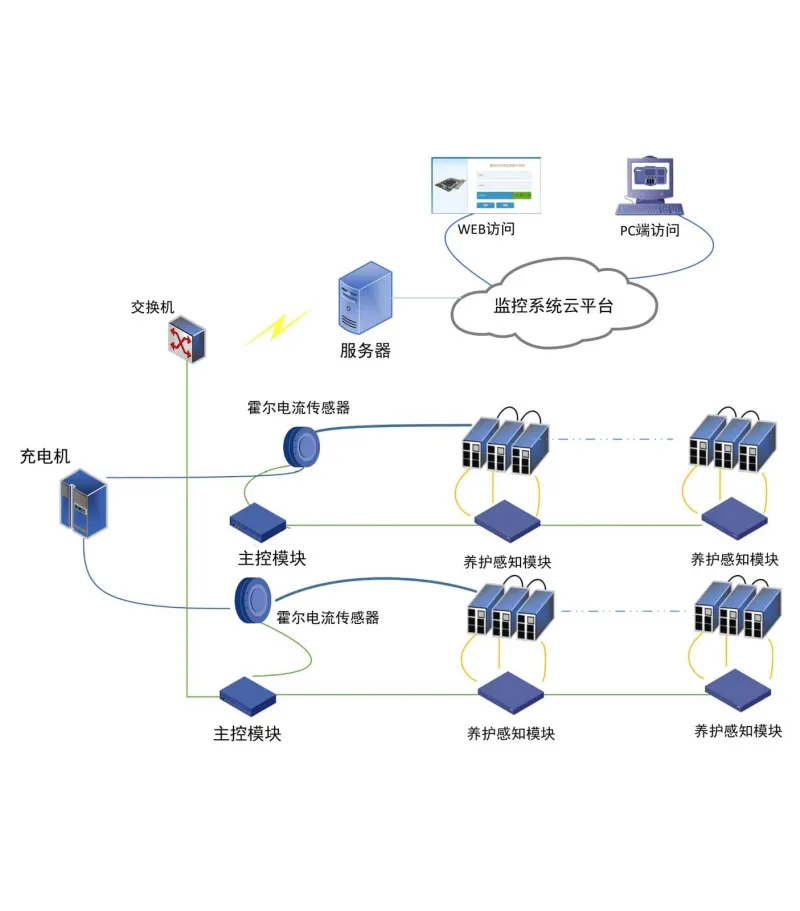
Main control module
Handles data acquisition, transmission and control between the system and batteries; cascaded for scalable management of packs at different sizes and voltage levels.
Maintenance module
Senses and maintains: loads specific pulse currents based on real-time cell status, communicating with the main control module over an industrial network.
Charger
Combines high-frequency switching power and embedded control; four-stage charging (constant current / W stage / reduced constant current) optimizes the charging curve and extends battery life.
Current sensor
Hall-effect solid-state sensor with wide range (5~10000A, 5~5000V), high accuracy, high sensitivity and strong interference immunity.
Maintenance server
Aggregates data from control modules, presenting real-time battery status, analysis and control commands to operators.
Maintenance software
The core of the system: real-time monitoring, data aggregation, analysis and control, maintaining degraded cells and alerting — full life-cycle management.
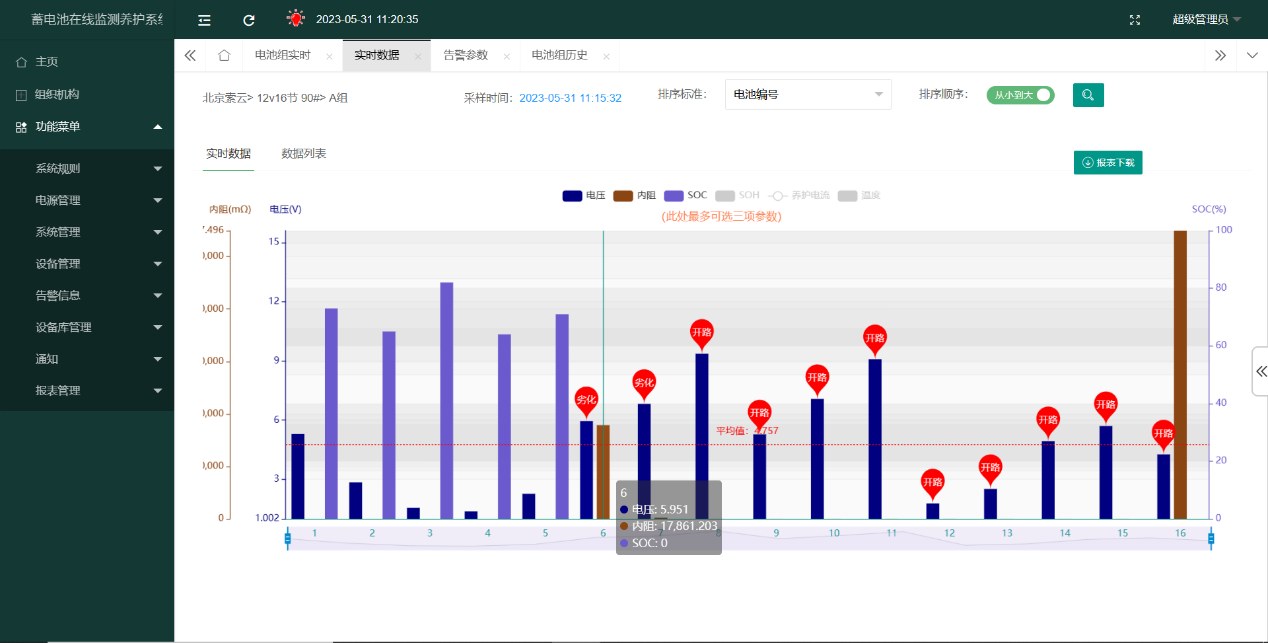
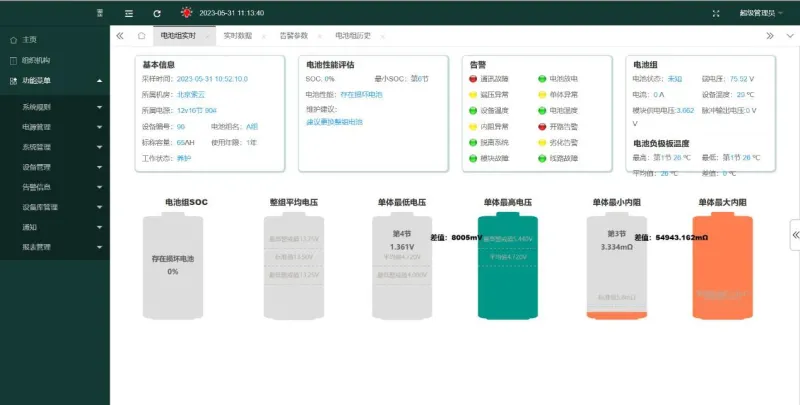
Monitoring data and analysis
Single cell
Voltage · Internal resistance · SOC · SOH · Negative plate temperature · Maintenance current
Battery pack
SOC · Average voltage · Cell min/max voltage · Cell min/max resistance
Trend analysis
Voltage curves · Current curves · Ambient temperature curves · SOC curves
Alarms
Discharge · Terminal voltage · Device temperature · Resistance · Cell anomaly · Battery temperature · Open circuit · Degradation
Technical specifications
| System | Specification |
|---|---|
| CAN bus | CAN2.0B (11-bit & 29-bit IDs); multiple independent data rates; custom message formats; field firmware upgrade and configuration; standard chargers/inverters; OBD2 compatible (multiple scan tools); CANOpen and J1939 integration |
| Battery compatibility | Lead-acid, NiCr and lithium-ion; 4 to 256 cells per system (or more) |
| I/O interfaces | 0–12V analog and digital signals; charge/discharge control |
| Diagnostics | OBD2 protocol for online detection, diagnosis and identification of problem batteries |
| Battery voltage | 1.5mV resolution; cell measurement range 0.5–5V; error <0.25% |
| Main control module | EUCC39 | EUCC16 |
|---|---|---|
| Cells maintained | 39 | 16 |
| Input voltage | DC110V or AC220V | DC110V or AC220V |
| Max power | 40W | 40W |
| Ethernet / Hall port | 1 / 1 | 1 / 1 |
| CAN ports | 2 | 2 |
| Size / Weight | 280×220×45mm / 1.5KG | 280×220×45mm / 1.5KG |
| Maintenance module | EUMM08 | EUMM04 |
|---|---|---|
| Cells maintained | 8 | 4 |
| Input voltage | 12V | 12V |
| CAN ports | 4 | 4 |
| Battery control ports | 9 | 5 |
| Size / Weight | 190×85×33mm / 0.5KG | 190×85×33mm / 0.5KG |
Field photos & software UI